Jul 31, 2026Buying Guides
PE Woven Hose vs PU-Lined Hose: What B2B Buyers Should Compare
Compare hose construction, pressure class, handling, abrasion exposure and intended use before choosing between PE woven and PU-lined hose families.

PE woven hose and PU-lined woven hose are not direct substitutes chosen by material name alone. PE woven products emphasize lightweight water transfer and repeated handling, while the supplied PU-lined family covers lined, textile-jacket constructions in higher documented pressure classes. The correct choice still depends on pressure, abrasion, coupling, temperature and the actual application.
At-a-glance comparison
Compare five fields in the product specification: liner and reinforcement construction, documented working and burst pressure, available inside diameter, expected handling or abrasion, and coupling requirements. A useful comparison keeps these fields side by side instead of relying on color, appearance or a generic hose label.
PE woven layflat hose
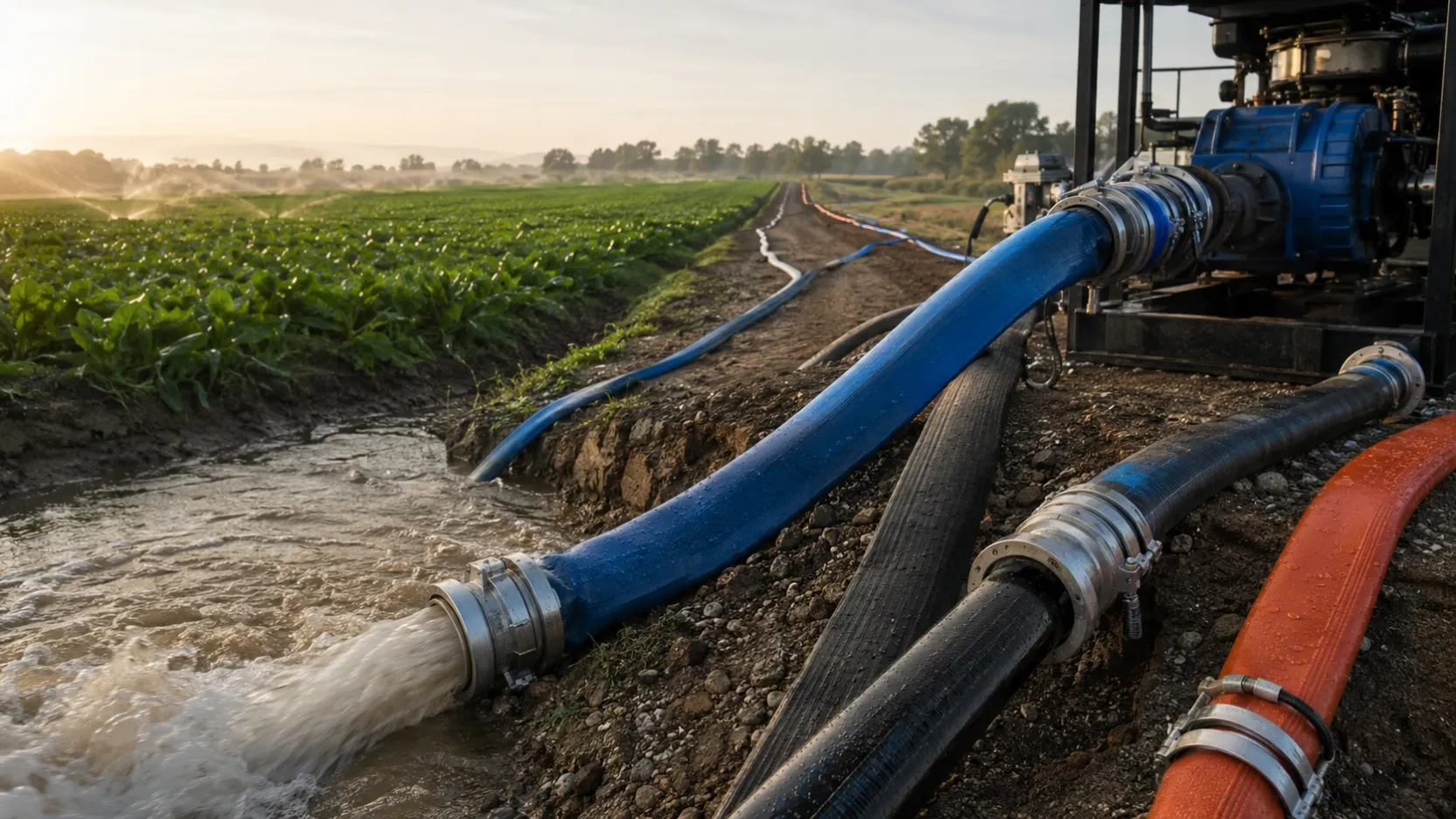
The supplied PE woven range uses polyethylene layers with woven polypropylene reinforcement. These products are positioned for agricultural irrigation, drainage, dewatering and outdoor water transfer where low weight, layflat storage and repeated relocation are useful.
PU-lined woven hose
The supplied PU-lined range uses a polyurethane liner with polyester reinforcement. It spans multiple documented pressure classes for irrigation and fire-support use. The pressure class, jacket construction, applicable test requirement and coupling must be checked for the specific product rather than inferred from the PU label.
How pressure changes the decision
Use continuous working pressure for selection and treat burst pressure as a separate value. Add pump surge, elevation, route length and valve operation to the brief. If the required duty sits near a product limit, ask for a system-level review instead of selecting by a nominal pressure label alone.
How handling and abrasion change the decision
Frequent dragging, rough construction ground and repeated deployment make abrasion and jacket protection important. A lighter hose may reduce handling effort, while a lined textile construction may be preferred for a different pressure or service requirement. State the real ground and movement conditions so this tradeoff is visible.
What to verify before purchase
Verify inside diameter, working pressure, burst pressure, roll length, liner and reinforcement, temperature, coupling, test or inspection documents, printing, packaging and order quantity. Request the product-specific table because one family name can include several pressure and size variants.
Selection answer
Choose PE woven layflat hose when the documented product fits the pressure duty and the project values lightweight irrigation, drainage or movable water transfer. Compare PU-lined woven hose when a lined textile construction and a higher documented pressure class are required. Neither material is universally better; suitability comes from the complete operating specification.
Frequently asked questions
Is PU-lined hose always higher pressure than PE woven hose?
The supplied catalog includes PU-lined products in higher documented pressure classes, but the exact values must be checked on each product page. Do not generalize one model's rating to every hose of the same material.
Which hose is better for frequent relocation?
Compare weight, abrasion exposure, route, coupling and pressure together. PE woven layflat hose is positioned for repeated outdoor handling, but the actual duty still controls the choice.
Can material alone confirm application fit?
No. Material is one field. Pressure, diameter, construction, temperature, abrasion, coupling and required testing must also match.